
The Imperial War Museum London is one of the few big-name London attractions that costs nothing to walk into, and it’s better than a lot of the ones that charge. You get six floors of galleries, a V-2 rocket standing upright in the middle of the entrance hall, and a Holocaust exhibition that ranks among the most carefully made in Europe. Entry is free. You don’t book. You just turn up.
I’d put it near the top of any London museum shortlist, and not only because of the price. The place has a clear point of view: war told through the people who lived it, rather than a parade of hardware with dates attached. The tanks and planes are there, but they’re the hook, not the whole story.
Why the Imperial War Museum London earns a half-day
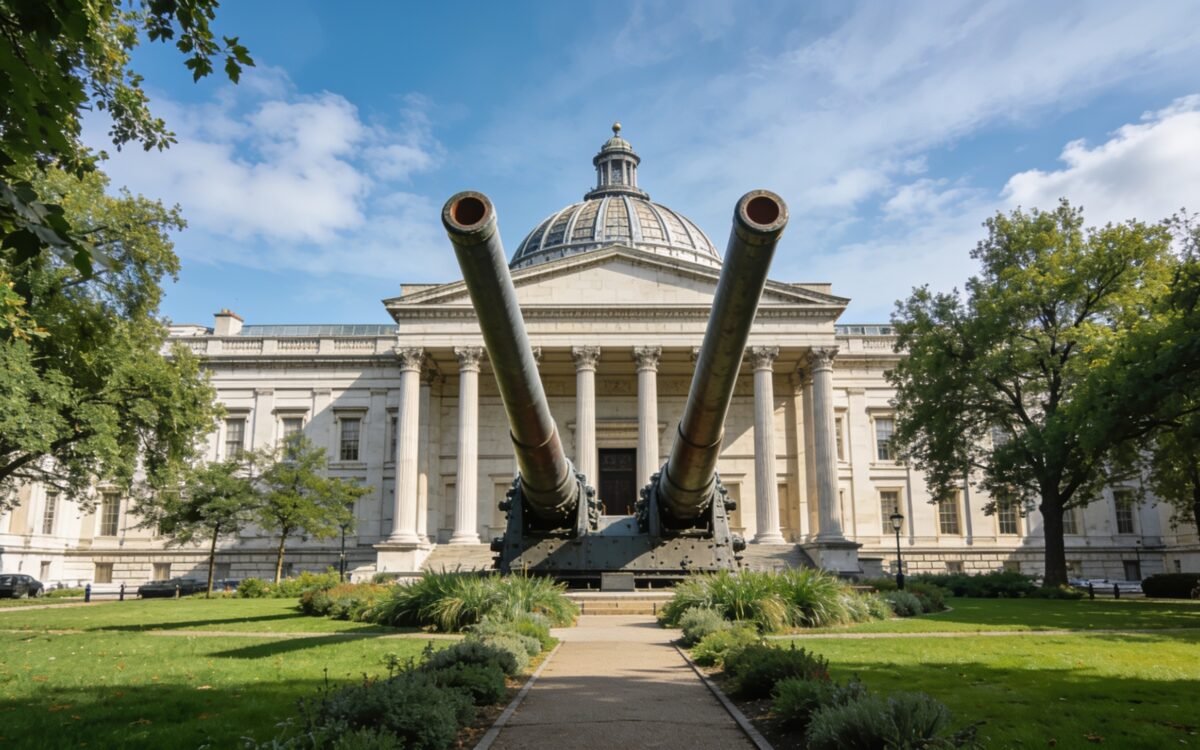
The building itself has history. It opened in 1917 while the First World War was still being fought, and since 1936 it’s occupied the former Bethlem Royal Hospital in Southwark, the old “Bedlam” asylum. Two enormous naval guns sit on the front lawn, pointing at the sky, which is your first clue about the scale of what’s inside.
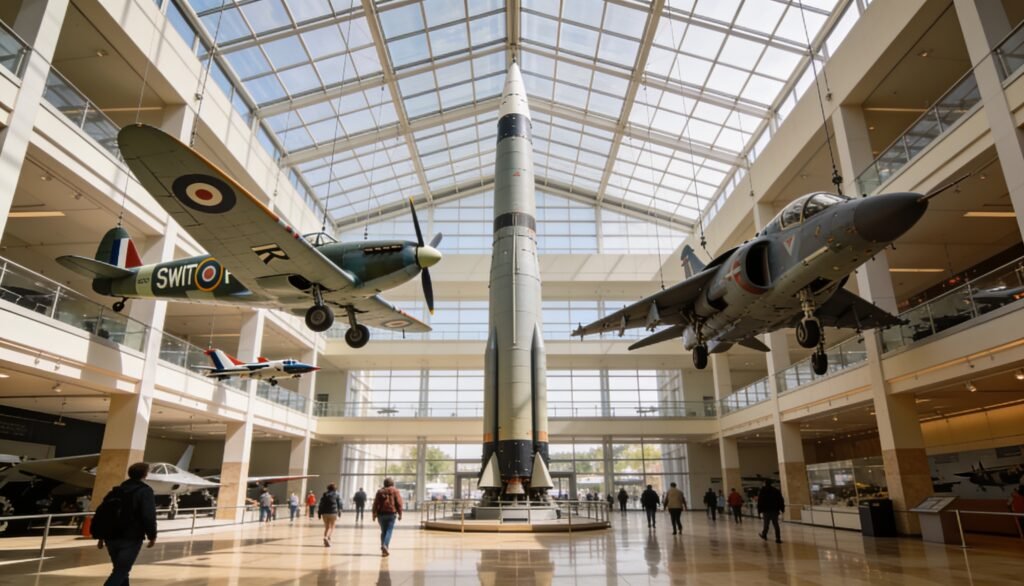
Walk into the atrium and look up. A Spitfire and a Harrier jet hang from the ceiling. A 14-metre V-2 rocket stands vertically in the centre of the floor. It’s the single most photographed spot in the museum, and for good reason. Most people spend ten minutes here before they realise the real depth is on the upper floors.
Plan for at least three hours if you want to do the main galleries properly. A full day isn’t overkill if you read the panels and watch the testimony films. Most visitors underestimate how much is packed in.
What to see first
The First World War Galleries run chronologically and take you from a front-line trench to a munitions factory back home. They’re well paced and give you the shape of the whole war without drowning you in detail.
The Second World War Galleries opened in 2021 as part of a £30.5 million project and won Permanent Exhibition of the Year at the 2022 Museum + Heritage Awards. They’re three times the size of the First World War Galleries, spread across six connected spaces, and built around more than 3,500 objects and personal accounts from over 80 countries. This is where the museum’s storytelling is at its strongest.
Between the Second World War and Holocaust Galleries hangs a 783kg V-1 flying bomb, one of the “Doodlebugs” that Germany launched at British cities. Over 10,000 were fired, and more than 6,000 people died. Many of the bombs themselves were built by concentration camp prisoners, which is why it sits at the exact point where the two galleries meet.
Don’t skip the Blavatnik Art, Film and Photography Galleries, which show war art and photography rather than weapons. There’s usually a free temporary exhibition running too. Recent programming included Beauty and Destruction: Wartime London in Art, showing how artists responded as bombs fell on the city in the 1940s. Check the official IWM site before you go, since these rotate.
The Holocaust Galleries at the Imperial War Museum London
These deserve their own section, and their own mindset. IWM London is the first museum anywhere to house dedicated Second World War and Holocaust galleries under one roof, and the Holocaust Galleries span two floors.
The approach is personal rather than statistical. Individual stories of some of the six million Jewish people murdered are told through more than 2,000 photographs, letters, artworks, and objects, from jewellery and clothing to toys and musical instruments. Gena Turgel’s wedding dress is here. So is the birth certificate of Eva Clarke, one of very few people born inside a concentration camp who survived past liberation.
It’s heavy, deliberately so. IWM’s own guidance is that the Holocaust Galleries aren’t recommended for children under 14. If you’re visiting with a younger family, plan your route around that. During busy periods you may also need to collect a free timed ticket from the info desk on level 0 to get in, even with general admission, so factor that into your timing.
Planning your visit to the Imperial War Museum London
Here’s the practical stuff in one place.
| Detail | Info |
|---|---|
| Admission | Free (donations welcome; the museum is a charity) |
| Opening hours | 10am–6pm daily, closed 24–26 December |
| Address | Lambeth Road, London SE1 6HZ |
| Nearest Tube | Lambeth North (Bakerloo), also Elephant & Castle, Waterloo, Southwark |
| Time needed | At least 3 hours; a half-day for the highlights |
| Café | Off the main atrium, 10am–5.30pm daily |
Lambeth North is the closest station, a short walk away on the Bakerloo line. Elephant & Castle and Waterloo are both within reach if you’re changing lines. Dozens of bus routes stop nearby.
Weekends and school holidays bring free children’s activities, which makes it a solid rainy-day option for families with older kids. The café off the atrium does hot and cold food and decent cakes, though if you want more choice, you’re a short walk from Waterloo and the South Bank.
One tip: go on a weekday morning if you can. The atrium and the new galleries fill up fast on weekends, and the timed-ticket system for the Second World War and Holocaust spaces kicks in exactly when it’s busiest.
Pairing it with nearby attractions
The museum sits within easy reach of the South Bank, so you can build a full day around it. The London Eye, SEA LIFE London Aquarium, and Tate Modern are all a short trip away. Big Ben and Westminster are roughly a 20-minute walk or one Tube stop.
If the war history grabs you, the Churchill War Rooms are the natural follow-up. They’re the actual underground bunker where Britain’s wartime government operated, kept close to how they looked in 1945, and they’re run by the same organisation. Note that this one charges, currently from around £33, and I’d book online in advance because the walk-up queue can eat an afternoon. (Prices shift and there are seasonal discounts, so check the current rate before you go.) IWM also runs HMS Belfast on the Thames, IWM Duxford in Cambridgeshire, and IWM North in Manchester.
Is it worth it? My honest take
Yes, easily. The free admission removes the “is this worth the ticket” question that hangs over so much of London, and what’s inside would justify a fee anyway. The Second World War and Holocaust Galleries are the reason to come. The atrium is the reason you’ll take photos.
If I had to name a weak spot, it’s that the modern-conflict and post-1945 material can feel thinner than the two world wars, which get the lion’s share of space and craft. That’s a minor gripe about a museum that gets far more right than wrong. Come with three hours, start upstairs before the crowds, and give the Holocaust Galleries the quiet attention they were built for.
Frequently asked questions
Is the Imperial War Museum London free?
Yes. General admission is free and you don’t need to book. It’s a charity, so donations are welcome but never required.
What are the opening hours of the Imperial War Museum London?
It’s open 10am to 6pm daily, and closed only on 24, 25, and 26 December. The café closes a little earlier, at 5.30pm.
How long do you need at the Imperial War Museum London?
Allow at least three hours for the main galleries. If you want to read the panels and watch the testimony films properly, a half-day or more is realistic.
Is the Imperial War Museum London suitable for children?
There’s plenty for older kids, but the Holocaust Galleries aren’t recommended for under-14s. Free family activities run on weekends and during school holidays.
What’s the nearest Tube station?
Lambeth North on the Bakerloo line is closest. Elephant & Castle, Waterloo, and Southwark are all within walking distance too.
Do I need to book tickets in advance?
No booking is needed for the museum itself. On busy days you may have to pick up a free timed ticket at the level 0 info desk for the Second World War and Holocaust Galleries.